
Liposuction is a cosmetic surgery procedure that uses thin cannulas to remove localised fat deposits that do not respond to diet and physical activity. It reshapes the body contour but does not treat obesity and is not a weight-loss method. Detailed journey: liposuction →
Liposuction in the coming years should be defined less by the quantity of fat removed than by the precision with which the volumes are analyzed and remodeled. The most plausible innovations already combine known building blocks – standardized photography, ultrasound, assisted cannulas and digital monitoring – with tools still being validated, such as algorithmic prediction of the result.
In summary
The closest advances concern 3D body mapping, intraoperative ultrasound, instruments capable of better control of depth and energy, as well as AI models to aid planning. Ultrasound and radiofrequency are already used in certain indications, but their benefits depend on the device and the experience of the surgeon. Automated navigation and reliable prediction of skin retraction remain under development.
At a glance: where each innovation stands
| Innovation | Current stage (according to this article) |
|---|---|
| 3D body mapping | Among the closest advances |
| Intraoperative ultrasound | Among the closest advances |
| Instruments with better control of depth and energy | Among the closest advances |
| AI models to assist planning | Among the closest advances |
| Ultrasound and radiofrequency | Already used for some indications; benefits depend on the device and the surgeon’s experience |
| Automated navigation, reliable prediction of skin retraction | In development |
Before the cannula: building a really useful 3D map
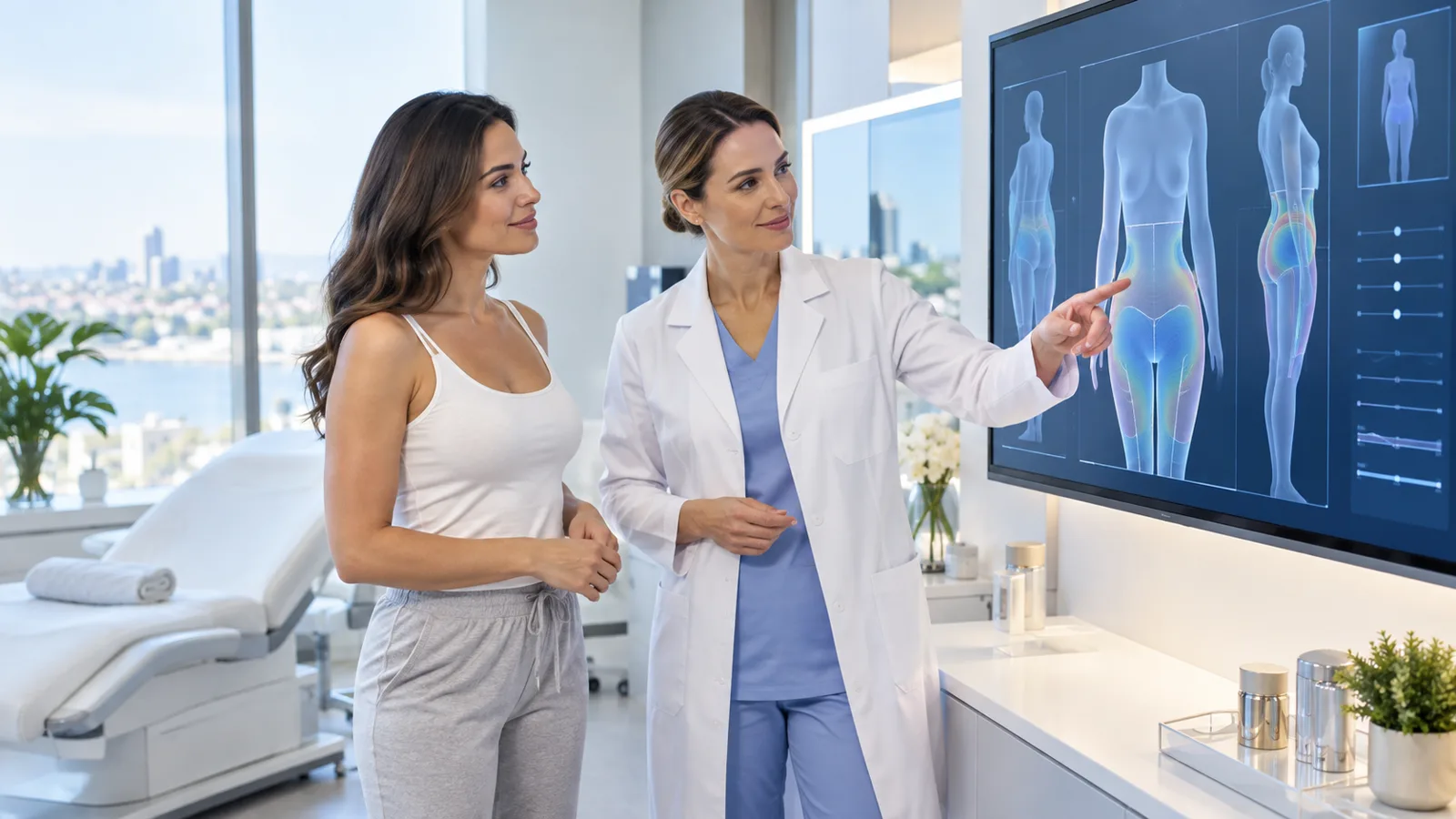
Three-dimensional photography already makes it possible to measure contours and asymmetries. The next step is to merge body surface area with data on fat thickness, skin quality and areas of fibrosis. A “digital twin” would not give a guaranteed result: it would be used to compare several scenarios and to document what is technically realistic.
Artificial intelligence could automate certain measurements, identify a discreet asymmetry and compare the evolution to standardized images. In 2026, this use must remain a decision aid. The available models are still sensitive to lighting, posture, the diversity of body types and the quality of the learning bases.
See under the skin during the procedure
Intraoperative ultrasound is a concrete development: it can help visualize anatomical planes and the position of the cannula. Recent publications describe liposuction under direct ultrasound vision, but the data remain limited and do not justify speaking of a new universal standard. In the short term, the main interest could be training, control of delicate areas and reduction of “blind” actions.
Pressure, movement or temperature sensors could then complete this visualization. Their objective would be to alert in the event of an unusual trajectory or accumulation of energy, without piloting the intervention alone.
Ultrasound, radiofrequency: better dosing rather than promising more
Ultrasound-assisted liposuction is already in use. It facilitates the preparation of fatty tissue in certain fibrous areas and in high definition sculpture. Subcutaneous radiofrequency aims at associated tissue contraction. These technologies are therefore not futuristic in themselves; the innovation lies in dose control, temperature measurement and patient selection.
The literature calls for caution: the levels of proof vary depending on the devices, and energy adds specific risks, particularly thermal. Future generations will need to demonstrate reproducible clinical benefit, not just technical sophistication.
High definition: moving from intuition to reproducibility
High definition liposuction seeks to reveal certain anatomical reliefs through differentiated work on the fatty layers. It is already practiced, but its selection of candidates and its evaluation criteria are not yet uniform. The expected progress mainly concerns standardization: volumetric measurements, digital anatomical markers, symmetrical comparison and better documented safety protocols.
Useful innovation should also help avoid overcorrection. A dramatic contour in an image is not necessarily natural in movement, nor durable when weight or skin changes.
Security will become a data system
A meta-analysis published in 2024 recalls that contour irregularities remain among the most reported complications. Tomorrow, the preoperative file could include history, treatments, thromboembolic risk, planned volume, operating time and expected recovery. Algorithms could signal an atypical profile, but their external validation will be essential before any routine use.
Connected monitoring can also progress: daily questionnaire, standardized photographs and alerts directing sooner to the medical team. However, you should never delay a consultation in the event of unusual pain, shortness of breath, fever or sudden swelling.
Where are these innovations?
- Already used: 3D imaging, ultrasound assistance, some radiofrequency technologies.
- Improving: intraoperative ultrasound, thermal measurement, volumetric planning.
- Still experimental: automated navigation and reliable individual prediction of the result.
In Istanbul, what criteria will really count?
For a liposuction in Istanbul, the presence of a recent device is not enough. It is necessary to understand its indication, the training of the operator, the protocol for preventing complications and the organization of follow-up after return. Estetic Univers can help prepare the questions and the medical stay in Istanbul, while the decision rests with the surgeon after an individual assessment.
It is also useful to consult patient journey and results keeping in mind that they do not predict a personal outcome.