
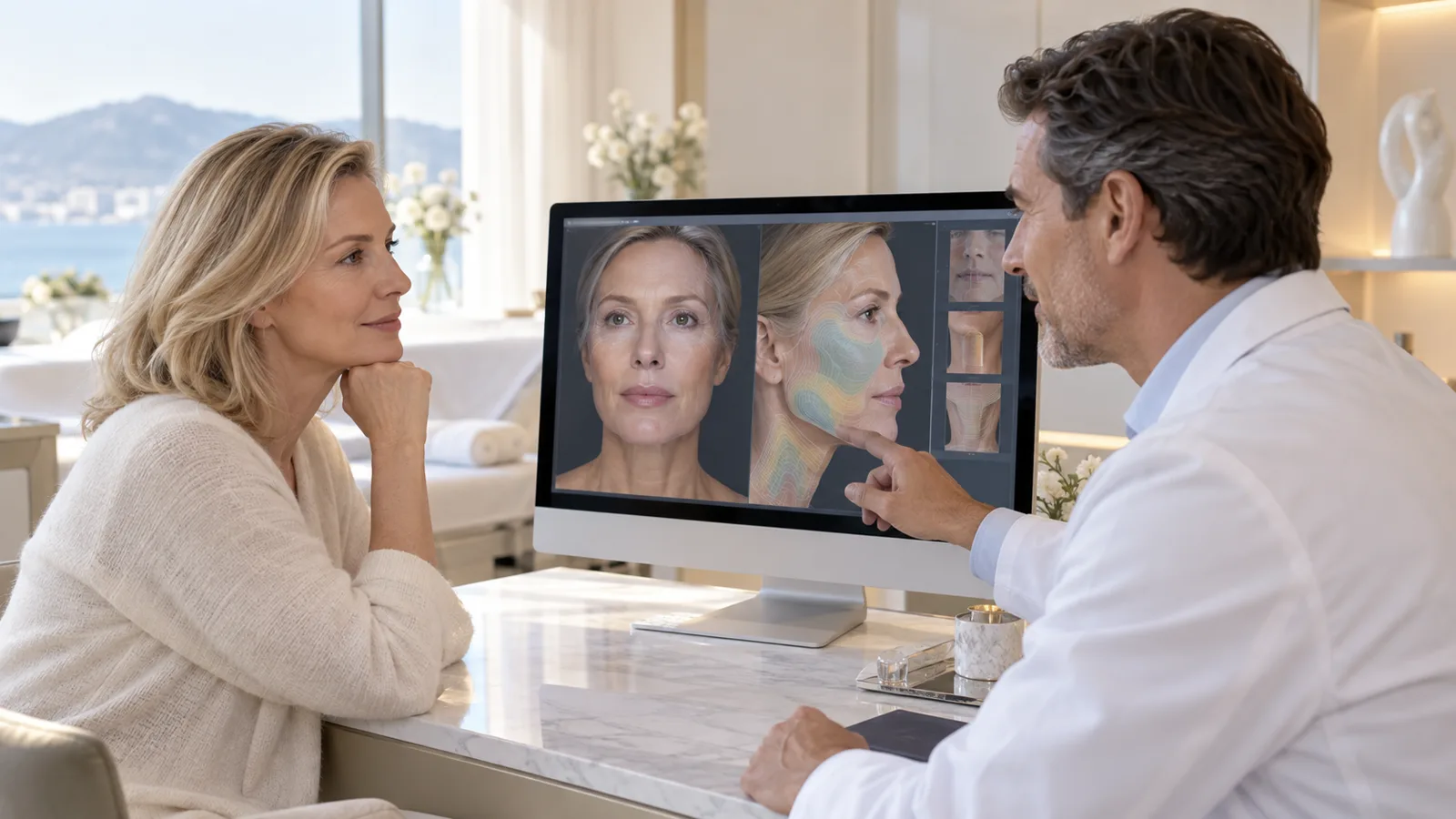
A lift is a cosmetic surgery procedure that tightens loose skin and tissue on the face, neck or areas of the body such as the arms, thighs or abdomen. Face lifts and body lifts meet different indications and are assessed separately by the surgeon. Detailed journey: face and body lift →
A facelift treats real sagging of the tissues. Future technologies should not make this anatomical reality disappear, but improve analysis, precision and repair. The face and the body require different strategies; their common point will be a more objective personalization.
In summary
The next developments will combine 3D facial and body analysis, AI to quantify aging, personalized planning of tensioning vectors, controlled energy for certain limited laxity and digital monitoring of scars. Biomaterials, hydrogels, cell therapies and antifibrotic treatments could improve wound healing, but many of these approaches remain experimental.
At a glance: where each innovation stands
| Innovation | Current stage (according to this article) |
|---|---|
| 3D facial and body analysis | Among the next developments |
| AI to quantify ageing | Among the next developments; already studied in facial aesthetics |
| Personalised planning of lifting vectors | Among the next developments |
| Controlled energy for certain limited laxity | Among the next developments |
| Digital scar monitoring | Among the next developments |
| Biomaterials, hydrogels, cell therapies, antifibrotic treatments | Many of these approaches remain experimental |
Measuring aging without reducing the face to a score
A 3D analysis can quantify tissue volumes, asymmetries, folds and displacement. Repeated over time and in movement, it could distinguish what is skin, fat, muscle or skeleton. AI is already being studied in facial aesthetics to improve assessment and planning.
An apparent age score should never dictate intervention. The face expresses an identity; the useful tool is the one that helps to preserve its characteristics, not to impose a standard model.
Traction vectors calculated for each anatomy
Future planning will be able to simulate several directions of re-tensioning and anticipate their effect on the cheek, oval or neck. Visual guides or augmented reality could report the markers to the block. The surgeon will always adjust according to the mobility and actual quality of the tissues.
The “deep plane facelift” corresponds to a family of anatomical approaches already practiced, not to a future technology. Its evolution mainly concerns the understanding of plans, training, selection and objective evaluation of results. It is not necessarily indicated for every face.
Energy: a supplement, not a universal facelift
Radiofrequency and focused ultrasound may seek to contract or remodel certain tissues. Devices are advancing in temperature measurement, depth targeting and uniform energy distribution. They may be suitable for limited releases or complete a strategy.
They do not remove significant excess skin. Presenting an energy treatment as the guaranteed equivalent of a surgical facelift creates confusion between different indications.
Reduce the scar by acting on its environment
Healing depends on tension, inflammation, vascularization and individual behavior. The biomaterials studied seek to modulate these signals: hydrogels, matrices, local drug delivery or mechanical supports capable of distributing tension.
Research is also exploring cells, PRP, stromal vascular fraction or derived products. The results are still heterogeneous, with protocols difficult to compare. An invisible scar cannot be promised.
Photographic monitoring will become earlier and more objective
Images taken with guided framing could track color, swelling, and closure of the incision. A help system can spot an unusual development and request verification. It does not replace the examination in the presence of increasing pain, fever, discharge or sudden asymmetry.
In the longer term, intelligent dressings could measure temperature, humidity or local tension. Their adoption will depend on evidence showing that they actually improve decisions and outcomes.
The body lift will benefit from the same precision
After significant weight loss, the sagging affects several areas and the scars can be long. 3D mapping could better plan resections, simulate closure and distribute interventions over time. The link with bariatric surgery and nutritional stability will remain essential.
Research on dermal matrices and tissue repair could be useful in certain complex defects, but it will not remove the constraints of skin excision.
On what horizon?
- Now: 3D photography, targeted anatomical techniques, energy according to indication and established scar care.
- Next years: dynamic planning, objective measurements and structured remote monitoring.
- Further: antifibrotic biomaterials, intelligent local delivery and advanced skin regeneration.
In Istanbul, favor a coherent strategy
For a face or body lift in Istanbul, it is necessary to verify that the technique responds to anatomy rather than a trend. The discussion should cover the location of scars, recovery, prevention of complications and follow-up upon return.
Estetic Univers can help organize the journey and prepare the questions. The results before and after give examples, but only a consultation allows a personal indication to be evaluated.