
Cosmetic surgery covers procedures that change the appearance of the face or body without the aim of treating a disease, such as rhinoplasty, breast surgery, abdominoplasty or blepharoplasty. Every project requires a consultation that examines the request, the possibilities, the risks and the limits. Detailed journey: cosmetic surgery →
Cosmetic surgery of the future is not just about robots. Its most credible evolution is a continuous digital journey: understanding the anatomy, simulating with caution, choosing an appropriate strategy, guiding the procedure then monitoring the healing. Several elements already exist separately; the real change will be their integration.
In summary
In the coming years, cosmetic surgery is expected to progress thanks to 3D and 4D simulations, AI models for risk analysis and prediction, augmented reality to superimpose the plan on anatomical landmarks, as well as biomaterials intended to improve tissue repair. Robotics will likely remain in focus. Regenerative medicine and “scarless” treatments remain fields of research, not available standards.
At a glance: where each innovation stands
| Innovation | Current stage (according to this article) |
|---|---|
| 3D and 4D simulations | Progress expected in the coming years; supports discussion, not a contractual result |
| AI for analysis and risk prediction | Progress expected in the coming years |
| Augmented reality (plan overlaid on anatomical landmarks) | Progress expected in the coming years |
| Biomaterials for tissue repair | Progress expected in the coming years |
| Robotics | Likely to remain targeted |
| Regenerative medicine, “scarless” treatments | Research fields, not available standards |
A consultation where simulation serves the decision
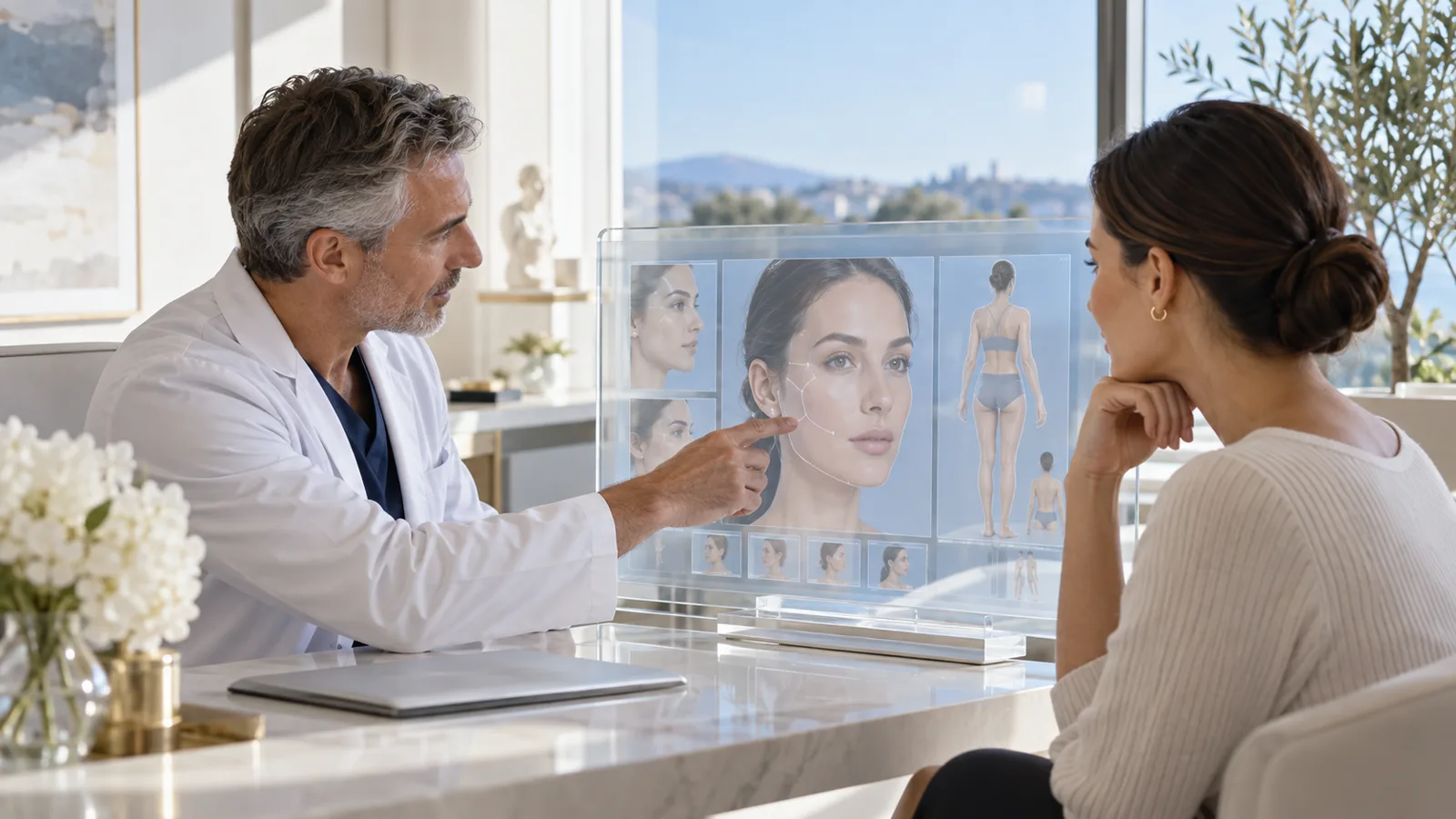
Surface scanners and 3D photographs already make it possible to observe volumes, asymmetries and proportions. A 4D simulation would add movement: smile, expression, posture or the effect of gravity. Its interest is not to produce a contractual “after”, but to make the discussion more concrete and to compare options.
Future software will have to display its margin of uncertainty. Healing, tissue mobility and the biological characteristics of a patient cannot be fully predicted by an image.
AI: predicting a risk rather than inventing a face
The most serious uses of artificial intelligence concern image analysis, classification of clinical situations, planning and prediction of complications. A 2024 systematic review on facial cosmetic surgery identified work on diagnosis, patient counseling and outcome prediction. It also highlights the heterogeneity of the data.
In the future, a model could combine history, analysis, type of intervention and photographic data to draw attention to a risk. It will remain a support tool: an algorithmic result must be explainable, controlled and applicable to the population concerned.
Will augmented reality enter the operating room?
Superimposing digital markers on the operating field could help to find an axis, a dissection zone or a planned volume despite changes in position. This approach is promising, particularly in reconstruction, but it requires very precise registration between the image and the real patient.
Robotics will be able to bring stability, miniaturization and repeatability to certain gestures. In soft tissue cosmetic surgery, complete autonomy seems distant: the tissues are deformed and the surgeon constantly adapts his strategy. The realistic scenario is that of assisted instruments, not of replacing the practitioner.
Biomaterials and regenerative medicine: the most experimental frontier
Matrices, hydrogels, cells from adipose tissue and biological products are studied to support repair, vascularization or scar quality. 3D bioprinting also opens up prospects for tailor-made fabrics. This research is important, but protocols, manufacturing and long-term safety must be standardized.
The terms “stem cells” or “exosomes” do not alone prove the effectiveness of a treatment. A commercial proposition must always be distinguished from a therapy validated for a specific indication.
The post-operative will become more visible
Guided photographs, questionnaires, thermography or connected objects could help track pain, mobility, swelling and scarring. AI could prioritize files requiring rapid contact. This hybrid tracking would be particularly useful after a trip, provided that a human team checks the alerts and an emergency circuit is defined.
Confidentiality is a major issue: facial and body images are sensitive data. Consent, retention period and access must be clearly explained.
From laboratory to practice
- Current practice: 3D photography, simulation and digital planning in several interventions.
- Gradual deployment: predictive models, targeted augmented reality and structured remote monitoring.
- Search: bioprinting, advanced regenerative biomaterials and soft tissue robotic automation.
Innovation in Istanbul: the right questions to ask
For a cosmetic surgery in Istanbul, it is relevant to ask who interprets the simulation, how the data is protected and what evidence supports the proposed scheme. Visible technology during the consultation does not say anything, on its own, about the quality of the diagnosis or follow-up.
Estetic Univers supports the preparation of the journey and facilitates access to practical information. You can also consult the patient reviews and the solutionspartner establishments before requesting a personalized exchange.