
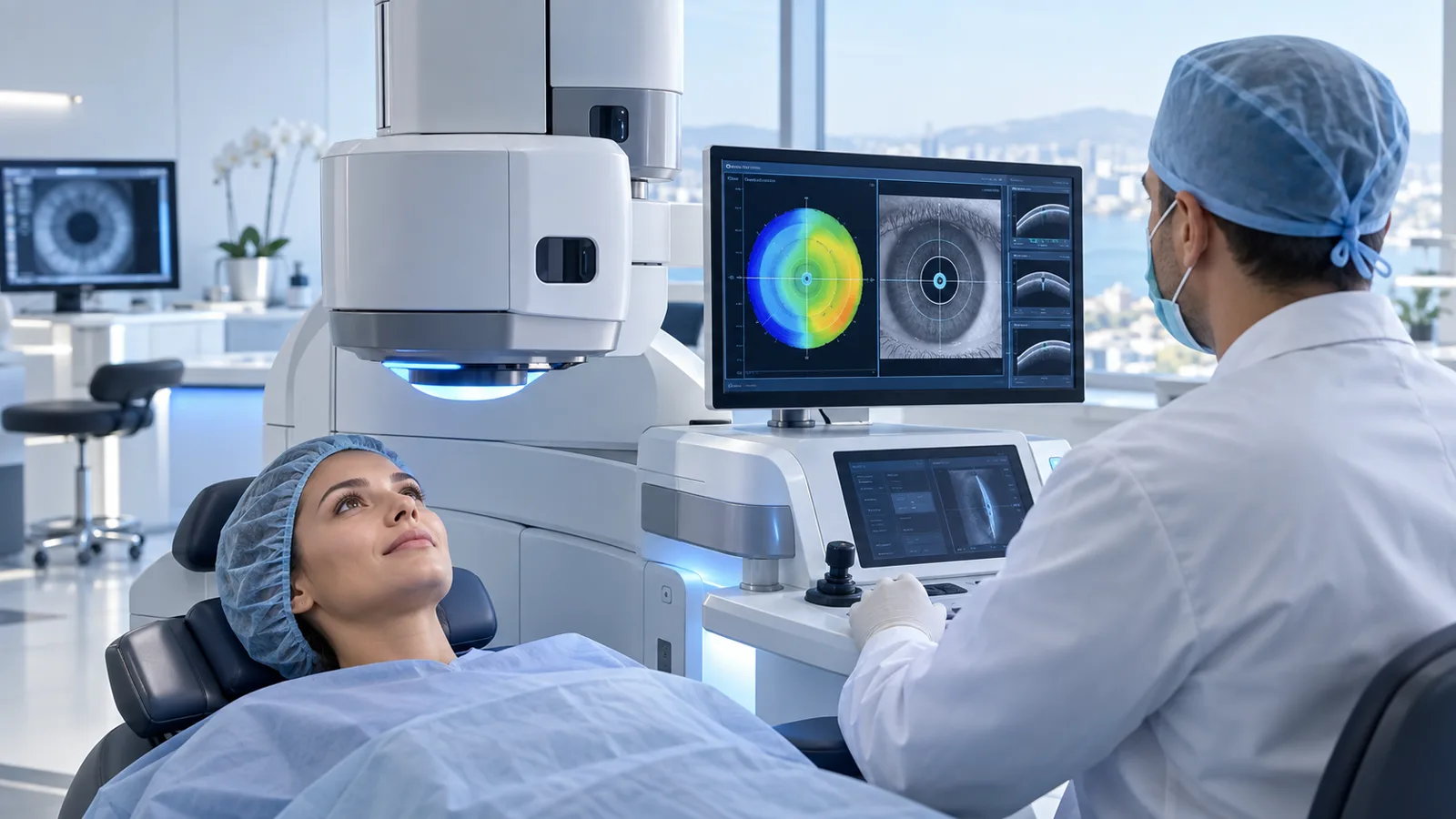
Laser eye surgery is a form of refractive surgery that reshapes the cornea to correct short-sightedness, long-sightedness or astigmatism and reduce dependence on glasses or contact lenses. The techniques (LASIK, PRK, SMILE…) are not suitable for everyone: only a full eye examination confirms the indication. Detailed journey: laser eye surgery →
Correcting myopia, hyperopia or astigmatism no longer consists only of applying a value in diopters. The cornea has its own shape, aberrations and biomechanics. Innovations in refractive surgery seek to integrate more data to select patients and personalize the procedure.
In summary
The closest advances combine corneal topography, aberrometry, ray tracing, faster eye tracking and AI models for screening and prediction. Lenticule extraction techniques like SMILE continue to evolve, while presbyopia correction involves lasers and advanced implants. Corneal regeneration or bioprinting remains primarily intended for research into corneal diseases.
At a glance: where each innovation stands
| Innovation | Current stage (according to this article) |
|---|---|
| Corneal topography, aberrometry, ray-tracing calculation | Among the closest advances; topography- or wavefront-guided treatments already clinical |
| Faster eye tracking | Among the closest advances |
| AI models for screening and prediction | Among the closest advances |
| Lenticule extraction (SMILE) | Existing technique that continues to evolve |
| Presbyopia correction (advanced lasers and implants) | Evolving field |
| Corneal regeneration or bioprinting | Mainly for research on corneal diseases |
From standard correction to individual optical map
Topography describes the corneal surface; tomography provides information on its structure; aberrometry measures more complex optical defects. These tools already exist. Their fusion could produce a plan that takes into account the entire light path, from the cornea to the retina, rather than just one measurement.
Treatments guided by topography or wavefront are already clinical. A randomized trial published in 2025 observed excellent results with two personalized LASIK strategies, without a single solution dominating all situations. The future will therefore be that of the right profile for the right protocol.
Eye tracking and femtosecond lasers: gaining control
Eye tracking systems compensate for micro-movements and rotation of the eye. Their next generations should integrate more anatomical landmarks and continuously check the alignment of the treatment. Femtosecond lasers will be able to improve the regularity of cuts and the adaptation of profiles.
More speed does not automatically mean more security. Calibration, quality of imaging, centering and experience of the surgeon remain decisive.
SMILE and lenticule extraction: what next steps?
The SMILE technique, which removes a corneal lenticule through a small incision, is already used for certain myopias and certain astigmatisms. A 2024 meta-analysis reports effectiveness, safety and stability generally comparable to other corneal surgeries, with nuances depending on the results studied.
Developments concern the careful widening of indications, centering, cyclotorsion compensation and management of touch-ups. The extracted lenticular tissue is also studied for future uses, but its therapeutic reuse is not a standard routine.
AI as a security filter
Artificial intelligence is being explored to detect discrete keratoconus, estimate the risk of ectasia, help calculate implants and predict a refractive result. A 2025 review describes these uses while recalling the problems of standardization and compatibility between devices.
The expected benefit is less an automatic decision than a systematic second look. A model trained on a limited population may be less reliable for another cornea type or another device; external validation is essential.
Presbyopia: personalization remains the big challenge
Presbyopia involves vision at multiple distances and tolerance for optical compromises. The innovations combine laser profiles, advanced phakic or intraocular implants and vision simulations. The goal is to better predict perceived quality, not just measured acuity.
No strategy is perfect for everyone. Halos, contrast, dry eyes and professional expectations should be discussed before choosing an approach.
Does the regenerated cornea belong to the same future?
Limbal stem cells, hydrogels and bioprinted corneas are progressing to repair diseased tissues or respond to the lack of grafts. This research is scientifically important, but it does not constitute a future alternative to laser in a person with a healthy cornea and a simple refractive error.
What is real, emergent or experimental
- Actual today: Personalized LASIK, femtosecond lasers, eye tracking and SMILE depending on the indication.
- Emerging: multimodal examination fusion, screening AI and planning by complete optical model.
- Experimental: corneal regeneration and biofabrication for applications beyond current refractive correction.
Vision correction in Istanbul: the examination remains decisive
For a laser eye surgery in Istanbul, the essential question is not to ask for “the most recent laser”, but to check the quality of the assessment: stability of the correction, corneal thickness and shape, tear film, pupil and visual expectations.
Estetic Univers can help organize the consultation and the stay. The information of general FAQ complete this preparation, without replacing the opinion of the ophthalmologist.