
Cosmetic and restorative dentistry covers implants, crowns, veneers and whitening, which meet different needs. The treatment plan, the number of sessions and any successive stays are defined by the dental surgeon after a clinical examination and imaging. Detailed journey: dental care →
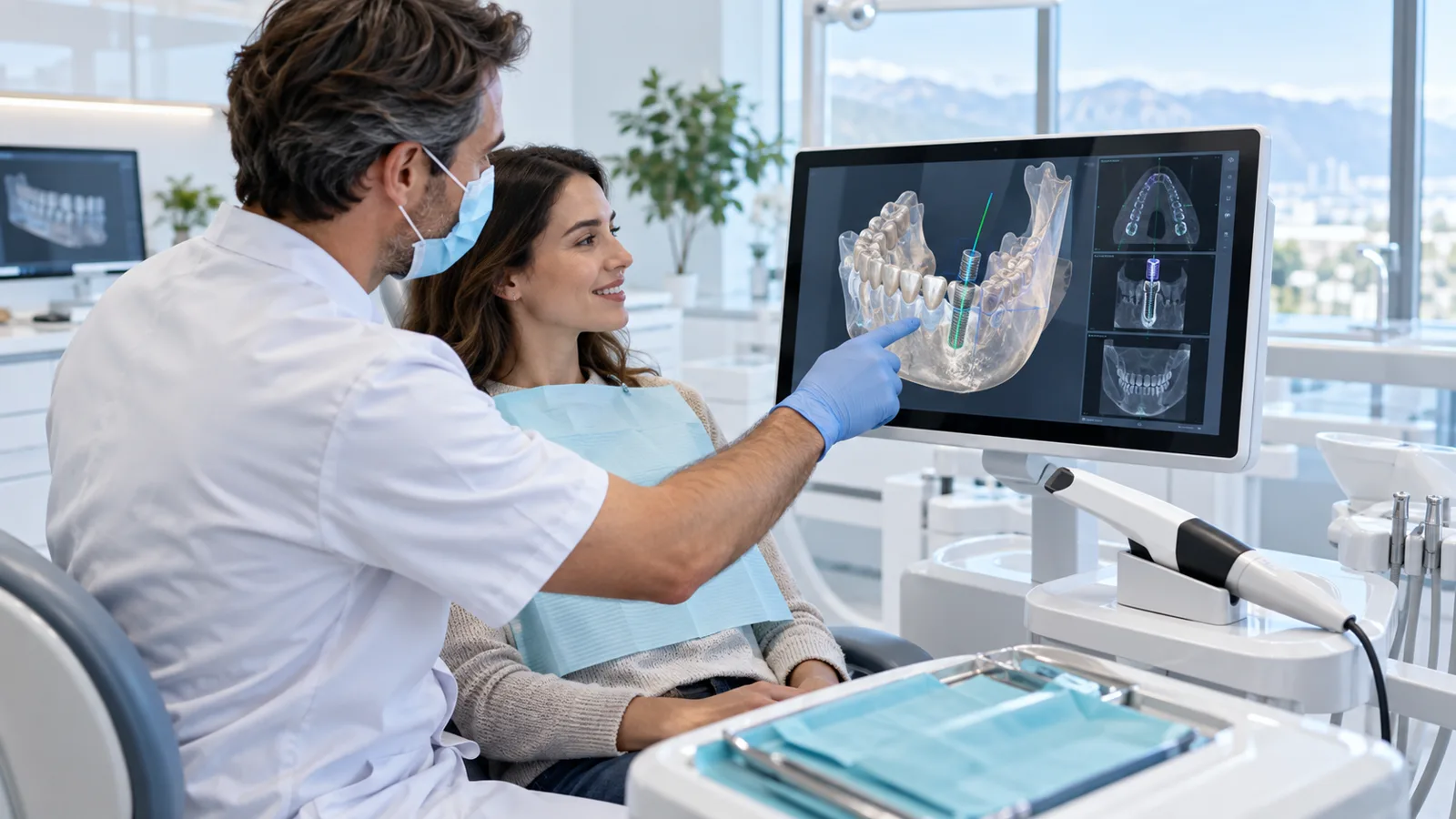
Implantology is one of the areas where digital technology has already changed practice: CBCT scanner, optical impression and 3D printed guides are used in many centers. The next step will be to reduce the gap between the virtual plan and reality during the intervention, then personalize the materials and the regeneration.
In summary
The most structuring innovations are CBCT–intraoral scanner fusion, AI to segment bone and nerves, dynamic navigation that follows the drill in real time and robotics with haptic feedback. 3D printing already allows custom guides and parts. Biomaterials, active membranes and bioprinted bone constructs are promising, but the most advanced regenerative solutions remain experimental.
At a glance: where each innovation stands
| Innovation | Current stage (according to this article) |
|---|---|
| CBCT – intraoral scanner fusion | Structuring innovation; CBCT and optical impressions already used in many centres |
| AI to segment bone and nerves | Structuring innovation |
| Dynamic navigation (real-time drill tracking) | Structuring innovation |
| Robotics with haptic feedback | Structuring innovation |
| 3D printing of guides and custom parts | Already possible |
| Biomaterials, active membranes, bioprinted bone constructs | Promising; the most advanced regenerative solutions remain experimental |
The digital twin of the mouth becomes the operating file
CBCT provides a three-dimensional image of the bone; the intraoral scanner captures teeth and gums; the photograph documents the smile. Merged, this data creates a model that can be used to virtually position the implant according to the available bone and the future prosthesis.
The expected innovation is a smoother update of this model. If an extraction or a gesture modifies the anatomy, the plan could be recalculated without starting the entire chain again. Quality will always depend on human acquisition and verification.
Three ways to guide the implant
The static guide
Printed from the plan, it constrains the trajectory. It is already common, but does not easily allow the strategy to be changed during the act.
Dynamic navigation
It tracks the instruments in real time and displays their position on the imagery, like a surgical GPS. It allows adaptation, but requires precise calibration and learning.
Robotics
Some systems add a guided arm or haptic limit. Recent meta-analyses report better average accuracy of computer-assisted methods compared to freehand placement, with a possible advantage of robotics. However, the number of clinical studies, costs and funding biases require cautious interpretation.
AI automates invisible tasks
Before any navigation, the bone, teeth, sinuses and mandibular canal must be segmented. AI can accelerate this work, suggest an implant axis and detect a radiological anomaly. It could also estimate primary stability or the need for transplantation from multiple data.
Responsibility remains clinical. An erroneous segmentation of a few millimeters can be significant near a nerve; each automatic proposal must be checked.
3D printing and truly personalized implants
3D printing already produces guides, models and certain prostheses. Advances in metals and ceramics are paving the way for implants or grids adapted to a complex bone defect. The design can optimize porosity, surface area and force transfer.
Customizing does not mean improvising: material traceability, mechanical validation, sterilization and regulation are as important as the shape obtained.
Regenerate bone rather than simply replace it
Membranes, bone substitutes and biological factors are already used according to indications. The research explores printed scaffolds, hydrogels, bioactive surfaces and systems that locally release molecules. The goal is to guide cells and vessels in order to obtain functional bone.
Bioprinting of vascularized tissues represents a more distant horizon. It should not be confused with the current printing of guides or inert parts.
Control will no longer stop at installation
Successive intraoral scans can compare the gum, occlusion and prosthesis without multiplying impressions. Force sensors and tracking apps could signal a change to check. No app alone diagnoses infection or bone loss; clinical and radiological control remains necessary.
The maturity card
- Installed: CBCT, optical impression, static guides and virtual planning.
- Growing: dynamic navigation, AI segmentation, implant robotics.
- Advanced search: bioactive scaffolds and bioprinted bone reconstruction.
Dental care in Istanbul: evaluating the entire digital flow
In a project of dental surgery in Istanbul, it is necessary to ask how the prosthetic plan guides the position of the implant, which validates the imaging and how the parts are traced. Sophisticated navigation does not eliminate biological risk or the need for rigorous hygiene.
Estetic Univers can facilitate exchanges with the teams and the organization of the stay. Of feedback on dental care can supplement information without predicting an individual outcome.