
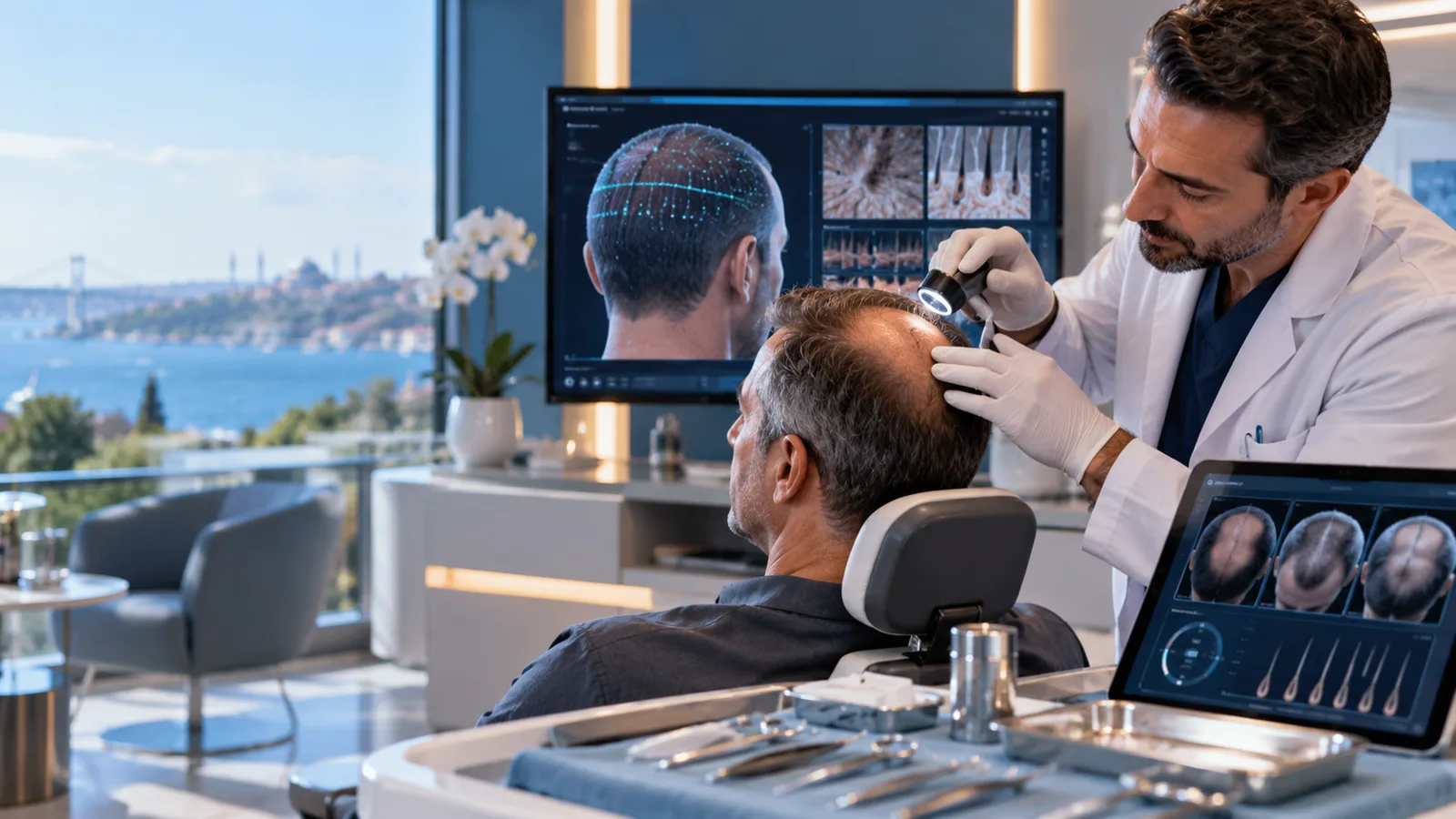
A hair transplant is a procedure in which hair follicles are taken from a donor area, usually the back of the scalp, and implanted into thinning or bald areas. The FUE, Sapphire FUE or DHI technique is chosen by the medical team according to the donor area and the area to be treated. Detailed journey: hair transplant →
Hair transplantation has already evolved a lot in recent years. Modern transplantation techniques now make it possible to collect and implant follicles with much greater precision than old methods. But the next development could go much further.
In 2026, research is particularly interested in several areas: artificial intelligence, automation of FUE, regenerative medicine, PRP, exosomes, stem cells and creation of follicles in the laboratory.
Some of these technologies are already beginning to be used in hair restoration, while others still remain experimental. Recent scientific publications emphasize the need to distinguish techniques with a sufficient level of proof from innovations still being evaluated.
For patients considering hair transplant in Istanbul, these advances could gradually enable ever more personalized treatments.
In summary
The next innovations in hair transplantation are expected to combine artificial intelligence, precision FUE, regenerative medicine, PRP, exosomes and research into the creation of new follicles. Some technologies are already being used as transplant aids, while stem cells and bioengineered follicles remain primarily experimental.
At a glance: where each innovation stands
| Innovation | Current stage (according to this article) |
|---|---|
| AI and scalp imaging | Potential aid to analysis before the procedure (density, follicles, available grafts) |
| Precision FUE (micromotors, punches) | Harvesting systems being improved |
| Robotics | Systems already exist to assist certain phases of extraction |
| PRP (platelet-rich plasma) | One of the most studied techniques; stronger level of evidence than other regenerative therapies |
| Exosomes, microneedle patches | Research avenues |
| Stem cells, bioengineered follicles | Mainly experimental |
Artificial intelligence to better prepare for transplantation
One of the important developments in hair transplantation concerns the digital analysis of the scalp.
Imaging systems associated with artificial intelligence can potentially help practitioners analyze numerous parameters before an intervention:
- density of the donor area;
- hair diameter;
- orientation of follicles;
- degree of miniaturization;
- surface showing a loss of density;
- number of available plugins;
- possible location of the future front line.
The objective is to obtain increasingly precise hair mapping.
In the future, these systems could also make it possible to simulate different scenarios before transplantation in order to help the surgeon plan the distribution of the grafts.
Artificial intelligence does not, however, replace medical expertise: it essentially constitutes an additional tool for analysis and planning.
An increasingly precise FUE
The FUE technique — Follicular Unit Extraction — consists of individually taking follicular units from the donor area before implanting them in the regions affected by alopecia.
Current innovations seek in particular to improve sampling systems.
Micromotors, punches and assistance devices can evolve towards better management of:
- the sampling depth;
- the angle of the follicle;
- the extraction speed;
- the diameter of the instruments.
The objective is in particular to limit the trauma inflicted on the follicles and to improve their conservation between collection and implantation.
We are gradually moving towards more technology-assisted hair microsurgery. To understand how this technique applies today, you can consult our hair transplant solutions.
Robotics and automation: what place in hair transplantation?
Robotics also represents an important avenue of development.
Automated systems already exist to assist certain phases of follicular extraction. New generations of devices could use imaging and recognition algorithms to more precisely distinguish follicles according to their orientation or density.
The objective is not necessarily to carry out a fully automated intervention.
The trend is rather towards a combination of precision technology, practitioner expertise and personalized patient analysis.
The human factor remains particularly important for the design of the frontal line, the aesthetic distribution of follicles and the long-term strategy.
PRP: biologically supporting hair transplantation
Regenerative medicine is probably one of the most exciting areas for the future of hair restoration.
PRP, or platelet-rich plasma, is one of the most studied techniques.
A recent scientific review indicates that PRP currently benefits from a higher level of evidence than several other experimental regenerative therapies.
Some studies have observed an increase in hair density, although the results specifically obtained in association with hair transplantation remain heterogeneous.
Current research mainly seeks to determine the best protocols:
- concentration of PRP;
- number of sessions;
- frequency;
- optimal timing in relation to transplantation.
Exosomes: a new avenue for stimulating follicles
Exosomes are currently one of the most studied subjects in hair regenerative medicine.
These are tiny vesicles produced by cells. They carry different biological signals capable of interacting with other cells.
Recent studies suggest that certain exosomes could be involved in several mechanisms associated with hair growth, including the activity of dermal papilla cells, vascularization and certain molecular pathways involved in the hair cycle.
The available results, however, remain heterogeneous.
Exosomes remain an emerging approach and should not be presented as a guaranteed solution for regrowth.
Microneedle patches to deliver treatments?
A particularly interesting innovation could concern not only the treatment itself, but also its method of administration.
Research focuses in particular on the development of microneedle patches and hydrogels capable of delivering certain substances directly to the follicle.
These technologies could improve the penetration of certain regenerative treatments.
However, these solutions remain mainly at the research stage.
Stem cells: regenerating rather than moving hair
Current transplantation is based on a simple principle: follicles are moved from a donor area to an area with hair loss.
The quantity available in the donor area therefore constitutes an important limit.
Research on stem cells and regenerative medicine pursues a much more ambitious objective: to stimulate or recreate the biological activity allowing the formation of a follicle.
Several types of cells and cell-derived products are currently being studied.
Many approaches remain experimental and still lack standardized protocols and long-term safety data.
Bioengineered follicles: the future “hair cloning”?
The most revolutionary prospect may be the creation of new hair follicles in the laboratory.
Rather than simply moving an existing follicle, researchers are trying to understand how to recreate the cellular interactions that allow the formation of a functional follicle.
We sometimes speak of hair cloning, even if this term greatly simplifies the scientific reality.
Researchers are exploring in particular bioengineered organoids and follicles capable of reproducing certain natural hair growth mechanisms.
This technology could, in the long term, profoundly change hair transplantation.
If new follicles could be reliably produced from the patient's cells, the limited amount of hair available in the donor area would become much less of a problem.
However, this possibility still belongs to experimental research.
Towards a totally personalized hair transplant
The next generation of hair transplantation will likely be a combination of several technologies rather than a single revolution.
The journey could gradually combine:
digital scalp analysis → artificial intelligence → personalized planning → FUE micro-extraction → precision implantation → digital monitoring → complementary regenerative treatments.
The objective would be to simultaneously improve the precision of the gesture, the preservation of the donor area and the personalization of the result. These advances will gradually complement patient results already obtained with current techniques.
Hair transplant in Istanbul: technology does not replace diagnosis
Istanbul is today one of the best-known international destinations in the field of hair transplantation.
However, whether it is a current FUE technique or a future innovation, one principle remains essential: technology cannot replace an individual diagnosis.
Before an intervention, several elements must be studied:
- the origin of hair loss;
- the probable development of alopecia;
- the quality of the donor area;
- the age of the patient;
- the available density;
- the patient's expectations.
As part of a journey organized with Estetic Univers in Istanbul, the patient can be accompanied in order to better understand the different stages, your stay in Istanbul and the solutions proposed by the medical team. For any questions, do not hesitate to contact Estetic Univers.